
It’s no secret that the construction industry is a major contributor to greenhouse gas emissions. As such, engineers and researchers constantly explore new technologies that align with sustainability goals while increasing productivity and reducing manual labor.
Take dry stone wall construction, for example. This manually intensive task dates back thousands of years and was historically used for fortification, agricultural terracing, and boundary delineation. Castles and defensive structures were also built stone-by-stone with precise placement for stability. In the 20th century, modern construction methods overshadowed such craftmanship and gave way to more timely built structures with less labor. However, interest has resurged in recent decades due to a growing appreciation for sustainable and traditional building practices.
Today, dry stone walls are valued for their aesthetic appeal and environmental friendliness. They are resource-efficient, as they use locally sourced materials low in embodied energy. And with advanced automation technology, builders can improve sustainability, reduce labor, and hasten projects — a dream of our ancient predecessors.
In the past two years, ETH Zurich researchers taught an autonomous hydraulic excavator to construct dry stone walls by itself as part of a digitally planned and autonomously excavated landscape and park in Oberglatt, Switzerland. The multidisciplinary team deployed the excavator to build a wall 65 m long, 6 m tall at its apex, and consisting of 938 individual elements (boulders and concrete demolition debris, with an average mass of over 1000 kg each), placing it among the largest robotically fabricated structures in existence.

The research aims to autonomously construct masonry structures on an architectural scale, using found and readily available materials, such as waste concrete and stones. Building with locally sourced boulders and waste concrete has the potential to drastically reduce the environmental carbon footprint of construction for specific applications. However, their production, calculation, and verification complexities make them less viable in modern construction. This project demonstrates that computational methods, machine vision approaches, and new control methods can be successfully integrated to handle the geometric variety of stone and rubble shapes in an adaptive building process that unfolds in an unstructured construction environment.
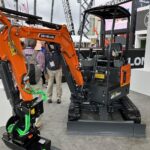
ETH Zurich’s Robotic Systems Lab developed the autonomous hydraulic excavator HEAP (Hydraulic Excavator for an Autonomous Purpose), a customized Menzi Muck M545 12t walking excavator, as part of a broader research endeavor.
“Hydraulic excavators are quite different from the precise electronic manipulators more commonly used in robotics applications. These differences include coupling effects between cylinders, dead zones, and delays associated with controlling multi-stage hydraulics, variable friction, and joint slop. Thus, automating these machines requires a control policy that can adapt to these variations to allow the tool to move in the desired way,” said Ryan Luke Johns, project manager and researcher at the ETH Institute for Architecture and Digital Fabrication.
“Working in outdoor construction environments also introduces challenges,” he continued. “Like autonomous cars, autonomous excavators need to use sensors, such as cameras and LiDAR, to measure the world around them, giving them a real-time virtual survey that can be used for decision-making. However, unlike cars, excavators reshape the world they operate in.”

Using sensors, the excavator can autonomously draw a 3D map of the construction site and localize existing building blocks and stones for the wall’s construction. Specifically designed tools and machine vision enable the excavator to scan and grab large stones in its immediate environment. It can also register their approximate weight and centers of gravity. An algorithm determines the best position for each stone, and the excavator places the stones in the desired location. The autonomous machine can place 20 to 30 stones in a single consignment — about as many as one delivery could supply.
“HEAP is a modified 12-ton Menzi Muck M545 ‘walking excavator’ equipped with multiple LiDAR sensors, cameras, IMUs (inertial measurement units), and GNSS receivers,” said Johns. “A combination of cabin and arm-mounted LiDAR sensors allows the machine to observe the full scene, including reaching over the in-progress wall to measure how stones are placed on the backside. Cameras help isolate individual stones in the 3D map produced by these sensors, and detected stones are picked up and revolved in the gripper to produce a full 3D scan of each object.”
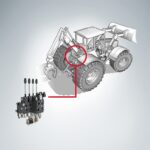
HEAP uses force-controllable cylinders and incorporates pressure and IMU feedback in the chassis. This allows for wheeled legs for automated load distribution and chassis balancing on irregular ground conditions.

“The large-scale retaining wall and landscape in Oberglatt, Switzerland, allowed us to demonstrate the capability of our system to perform incredibly complex tasks autonomously in a real construction environment,” said Johns. “Given that experience, we are working now to commercialize that technology as an ETH spin-off company, Gravis Robotics. At Gravis, we provide automation solutions for generalized construction equipment, leveraging state-of-the-art machine-learning-based control.”
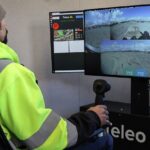
In addition to landscaping and stone-wall building applications, HEAP has been used for trenching, tree harvesting, and teleoperation.
ETH Zürich
ethz.ch
Gravis Robotics
gravisrobotics.com