

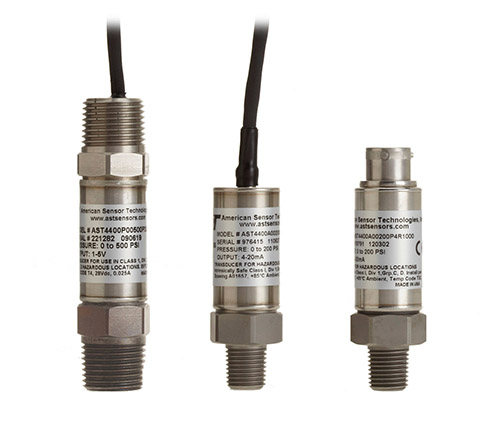
 Pressure transducers are used in any fluid power application requiring a high-resolution and accurate electronic measurement of pressure. A transducer is a device which changes one form of energy into an electronic signal. A pressure transducer reads the movement on its load cell as created by the pressure of the air or hydraulic fluid, and then using input power, provides an electronic output to be used by a PLC, display or other controller.
Pressure transducers are used in literally every application requiring a measurement of pressure–and then some! With integrated digital display, a transducer can be used to measure main hydraulic pressure right after a pump, or in a subcircuit where pressure might be different. In a pneumatic system, pressure transducers can be used at the receiver to monitor primary pressure, or at every FRL to measure pressure at each leg.
Pressure transducers are used in closed-loop applications, such as electronic pressure compensation, which will measure pressure upstream and downstream of a proportional metering valve to accurately measure pressure drop. The PLC will compare the difference in upstream and downstream pressure to the desired pressure drop set point, and adjust the valve to maintain that pressure drop regardless of load induced pressure fluctuations.
Another sophisticated application for a pressure transducer is for closed-loop pump control. For example, a fixed displacement pump can be controlled to behave like a variable displacement, pressure compensated pump by varying its speed with a servo- or VFD-driven motor. The PLC simply maintains the pre-set “compensator” pressure by varying pump speed to keep up with flow demands, regardless of load pressure.
A pressure transducer can also be used as an electronically variable pressure switch. In pneumatic applications, the directional valve used to operate the accumulator fill function can be switched by the PLC based on pressure from transducer. The machine operator, or the logic of the programming, can vary the accumulator pressure as required to modify the subsequent operating pressure. Higher pressure in an accumulator could also vary the usable volume of air to be discharged, since higher pressure equals higher volume.
Pressure transducers can also take the form of self-contained control units, such as a programmable digital pressure switch. A programmable digital pressure switch is self-contained, requiring only a power source to provide an accurate switched output anywhere in its usable range. Higher end models will also contain a digital display, not only for pressure readout, but to make programming easy. Going a step further, some models also have analogue outputs to feed into an additional controller or PLC.
Stand-alone pressure transducers require a power source, typically 24 V, and will then use onboard electronics to convert the mechanical pressure input into an analogue output. This output overwhelmingly one of three signals, either 0-5 V, 0-10 V, or 4-20 mA, which are the most common accepted by controllers.