

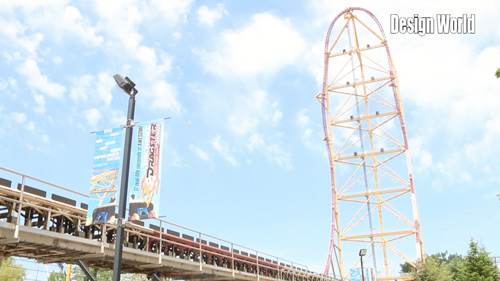
 As it embarked on yet another one of its record-breaking, thrill-seeking rides, Cedar Point quickly turned to hydraulics, for the power density and precision control it offers.
In our fifth and final installment of Design World’s Summer Tech Vacation video series, Editorial Director Paul Heney spoke with Monty Jasper, Corporate Vice President for Safety & Engineering for Cedar Fair about the engineering behind the Top Thrill Dragster.
Although the ride only lasts about 20 sec, it’s a favorite with visitors, as it sends riders from 0 to 120 mph in less than 4 sec, slinging them up and over a 420 ft hill in the blink of an eye.
No other technology could accomplish this feat in the small space required, said Jasper. “It is possible to do that with a LIM (linear induction motor) launch but it requires more space. And we were tight on the footprint that we could put the ride in. So we went with a hydraulic launch because we just didn’t have the land to get the ride in,” Jasper said. “Hydraulics was the one that could do the trick.”
Launching the trains and riders, which can be upwards of about 15,000 lb when loaded, requires about 10,000 hp. So before the ride begins, hydraulic oil is pumped into a cylinder, which presses against nitrogen. Compressing the nitrogen makes it act like a spring, Jasper said. Once the pressure reaches 320 bar (4700 psi), the system holds it. A train enters the station, and attaches itself to a catch car that has cables pulling it. These cables are wound around a drum at one end and a take-up reel on the back end.
“And when we’re ready to launch, that pressurized hydraulic is released and runs through 32 hydraulic motors and spins them up to speed, spins the drum, drags the cable and pulls the train down the track and accelerates you from zero to about 120 mph and it just sling-shots you, just like you would an aircraft carrier, when it launches the plane off the deck,” Jasper said.
Momentum and gravity carry the train over the tower and magnetic brakes slow and stop the ride.
A system with such high pressures and that requires such high precision is complicated, though, said Jasper and it took Cedar Point a few years to truly get the system operating at its peak performance. Maintenance and system evaluation are critical.
“It’s a cool system but it’s highly complicated. We have it running better, much better now than when we first put the ride in 2003. As you may know, we had a lot of problems in 2003-04 and that by itself is almost a success story, that’s not heralded much,” Jasper said. “I think the first year, we did about 600,000 riders on the ride because of all the problems we had on the ride. I think now we do regularly 1.2 million, so we doubled the capacity on the ride after a few years of operation because we made the system much more reliable.”
Watch our on-site interview to learn more about powerful hydraulics on Top Thrill Dragster. And tune in for all five videos in the Summer Tech Vacation series, with looks at the variable speed drives on the Gatekeeper, the linear induction motors on Wicked Twister, and pneumatics on Power Tower.