
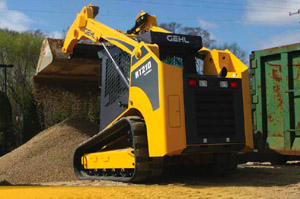
 Gehl’s RT Series Compact Track loaders are designed for earthmoving applications on rough, loose terrain. As any loader operator knows, keeping the tracks themselves properly tensioned can be a challenge.
“According to track and undercarriage manufacturers, one of the biggest causes of premature track and undercarriage component failures is improper track tensioning,” said Bob Claas, the company’s Design Engineering Manager. “Different types of premature component wear or failure can occur if the tracks are too tight or too loose.”
Gehl’s HydraTrac Automatic Track Tensioning System eliminates the need for manually tensioning the tracks on the loader before operation. When the machine is started, the hydraulic system automatically pressurizes a load device that provides the ideal tension for the track system. The HydraTrac System uses this excess hydraulic pressure to maintain proper track tension during use. The HydraTrac System not only saves time on the jobsite, but also increases the life of the tracks and bearings by ensuring the proper tension immediately upon start-up and tension release when the machine is shut down.
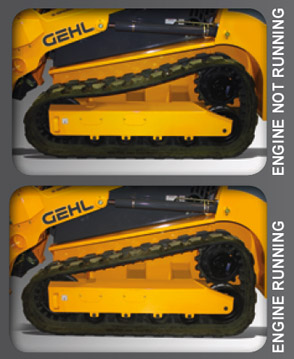 “Over-tensioned tracks not only increase wear, but also require more horsepower to drive and turn the loader,” said Brian Rabe, Track Loader Product Manager. “HydraTrac System ensures that all hydraulic horsepower is efficiently utilized, resulting in high performance with reduced owning and operating costs.”
What’s more, Claas explained, is that the RT Series feature a selectable propel “limp home” mode, which allows for reduced machine movement in the event of a transmission error. This allows for the machine to be moved to a safe location for maintenance. No other track loader has this feature
Competitive machines use either grease tensioning or mechanical adjustments or their tracks—both types of systems need to at least be monitored for adjustment every day.
Adaptable engineering
The high-torque engines on the RT Series also feature AntiStall technology, which senses machine load electronically and continuously monitors and adjusts the hydrostatic drive pump displacements to manage available engine horsepower and torque. This optimizes machine performance during heavy-duty cycles, but does not allow the engine to stall. This results in faster cycle times and less wear and tear on the engine, battery and starter.
According to Claas, diesel-powered, closed-loop hydrostatic pump and motors controls the propel system that automatically compensate for different hydraulic oil temperatures. This self-compensating feature is not found on mechanically or hydraulically controlled machines.
Joystick controls are mounted directly to the suspension seat frame, allowing them to move with the operator as the machine travels. This significantly reduces operator fatigue, enhances comfort in even the most adverse conditions and allows precise control for performing delicate tasks.
The standard electrohydraulic “5×5” Drive Control System gives the operator the option to choose from five drivability settings that change five control settings (joystick sensitivity, position reaction, engine response, anti-stall and pump swash plate position) to provide an active system that matches application and operator preference. This results in a matched performance to operator preference ratio.
Class told Design World that the the control software for the adjustable controls and engine anti-stall system mentioned above is very complex and therefore offered many challenges and took many design hours to perfect.
“With the design coming from a “clean piece of paper”, many aspects of the design are a first for the company, so there was very little past experience from other company products to reference,” he said. “During the design process, we used several experienced operators from the construction field to evaluate the design. We used this feedback to continuously improve many aspects … this was especially true in the software design.”
Class noted that the maximum engine horsepower was actually decreased from the initial design, but this did not negatively affect the performance or productivity of the machine. This was due to the development of the engine anti-stall system and the fact that the maximum engine torque only decreased minimally.