

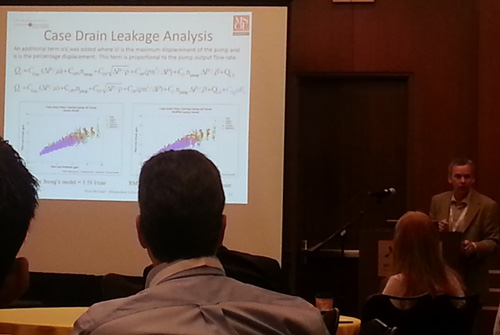
Leakage and system efficiency are always at the top of fluid power users’ minds. This is why several CCEFP researchers are focusing on how to optimize system sealing and fluids at the Center’s second annual Fluid Power Innovation & Research Conference 14 at the Marriott at Vanderbilt University in Nashville.
Kicking off a track on Tribology, Seals and Fluids was Milwaukee School of Engineering’s Paul Michael, Research Chemist with the Fluid Power Institute at MSOE. Michael highlighted the Institute’s study on hydraulic fluids, as it works to determine which types of fluids are most efficient in different hydraulic pumps and motors.
The goal of the research is to “improve hydraulic component and system efficiency through hydraulic fluid research,” Michael said. In previous studies, researchers have seen significant improvements in the low-speed mechanical efficiency of motors, through dynamometer and bench top fluid testing.
The most recent research Michael presented was done on four fluids—HM46-1 (an ashless mineral-based basic hydraulic oil; HV46-1 (a base stock with a viscosity index improver); HEES46-1 (an ester synthetic environmental oil); and HBMO (a high bulk modulus polyphenol ester oil).
Studying the fluids in a variety of motors and pumps and at different pressures and temperatures indicated that viscosity increases with pressure, and at low speeds, there is low friction.
MSOE researchers measured system leakage flow by defining four elements—case drain flow of the pump, control pressure flow of the compensator, flow losses in the directional control valve, and leakage flow from the case drain of the hydraulic motor.
Michael said it was not surprising to find that as pressure and temperature go up, leakage flow goes up. In addition, efficiency increases with pump input power.
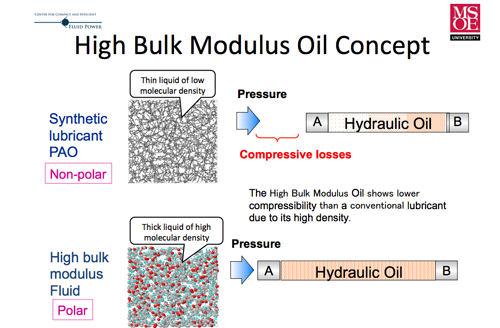
They studied a Parker geroler motor, Poclain radial piston motor and Danfoss axial piston motor, and overall, after reviewing more than 4000 data points, they determined there was about a 3% difference in the mean motor mechanical efficiencies for the fluids from the baseline fluid to the top performer, which was the high bulk modulus oil. There was a 20% difference in the mean leakage flow of the system for the fluids.
In conclusion, Michael said, at low speeds, motor mechanical improvements of 7 to 16% were observed, while at full range conditions, motor mechanical efficiency improvements were between 2 and 5%. Over the full range of conditions, mean system leakage flow reductions of 17 to 21% were observed.
Finally, the biggest conclusion drawn was that modeling suggests that density and bulk modulus may affect leakage flow more than viscosity, as the high bulk modulus fluid exhibited the lowest leakage flow rate.
The studies will continue with a swashplate angle sensor added and more work on the Stribeck model.